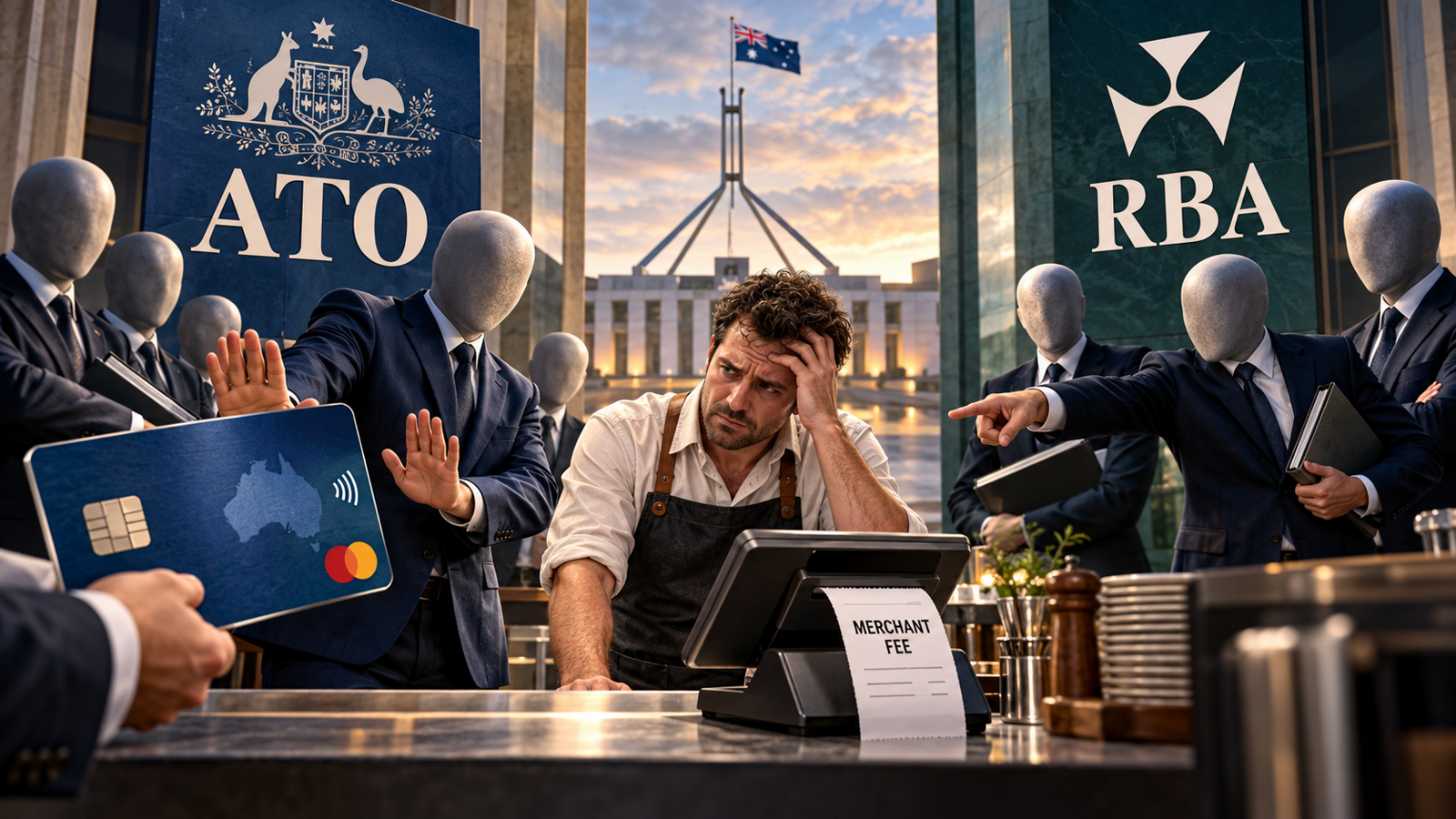
When Bureaucracy Meets Reality: The ATO Discovers That Card Payments Cost Money
In a development so perfectly absurd that it could only come from government, the Australian Taxation Office has announced that it will stop accepting credit-card payments after 30 November 2026.
Why? Because accepting credit cards costs money.
Yes, apparently merchant fees are a genuine and significant business expense when the ATO has to pay them. But when an Australian café, restaurant, retailer or other private business incurs exactly the same expense, the official response is effectively: absorb it, increase your prices or find yourself a cheaper payment provider.
Welcome to modern Australian economic policy, where bureaucracies make rules for businesses and then quietly excuse themselves when those rules become inconvenient.
The RBA’s “solution”
From 1 October 2026, the Reserve Bank of Australia changed its regulations to allow card networks to prohibit merchants from applying surcharges to eftpos, Mastercard and Visa payments. Those networks promptly introduced no-surcharge rules. American Express, UnionPay and PayPal have also moved to eliminate surcharging.
Businesses still have to pay the cost of accepting those cards, of course. The merchant fee has not magically disappeared. The banks and payment providers have not suddenly become charitable organisations. The expense simply has to be recovered elsewhere.
The RBA’s official advice is that businesses can incorporate card-processing costs into their overall prices. In other words, instead of allowing the customer who chooses a costly payment method to pay its cost, every customer can now help pay for it—including those using cash or less expensive payment methods.
That is apparently considered progress.
The government says the reforms will save consumers approximately $1.6 billion in card surcharges each year while saving small businesses $910 million through lower costs and greater transparency. Those promised savings will be worth watching closely. A reduction in one component of card-processing costs does not necessarily eliminate the total merchant fee paid by a business, and a government press release is not the same thing as a merchant statement.
Then the ATO encountered the real world
The Australian Taxation Office has now announced that, from 1 December 2026, it will no longer accept credit cards for taxation payments.
The timing could hardly be more revealing.
Private businesses are told that accepting cards is part of doing business and that the associated cost should be absorbed into their general pricing. The ATO, confronted with the same commercial reality, has selected another option entirely: it will simply stop accepting credit cards.
Apparently, recovering the cost through a surcharge is unacceptable.
Absorbing the cost is also unacceptable—at least when the ATO would have to do it.
So the payment method disappears.
It is a magnificent example of bureaucratic policy colliding with practical reality. The private sector is expected to comply, adjust its systems, change its pricing, explain the changes to customers and carry whatever costs remain. The bureaucracy, meanwhile, can remove the inconvenient payment option and direct taxpayers somewhere else.
A restaurant cannot realistically tell customers, “Credit cards cost us money, so we have decided not to accept them.” In an increasingly cashless economy, doing so could drive customers straight to a competitor. Yet the ATO does not face normal competitive pressure. Taxpayers cannot simply choose another tax office offering more convenient payment terms.
That must be nice.
Small businesses do not have the ATO’s choices
For hospitality venues, card acceptance is no longer an optional convenience. It is an essential part of normal trade. Customers expect to tap a card or phone, and many carry little or no cash.
A venue therefore has three practical choices:
- absorb the remaining merchant fees and accept a reduction in profit;
- increase menu prices so that every customer contributes to those fees; or
- introduce a properly disclosed general fee that applies independently of the customer’s payment method.
None of these options makes the underlying cost disappear. They merely change where it appears.
Government agencies can withdraw a payment option without losing their customers. Restaurants, cafés and retailers cannot. That is the crucial difference that seems to vanish whenever policy is designed from an office rather than from behind an actual counter.
This is not simplification—it is cost redistribution
Calling the removal of surcharges a cost-of-living measure makes for an attractive headline. But preventing a business from separately identifying an expense does not eliminate that expense.
The cost will still be paid.
It may be hidden inside every menu item. It may reduce already thin business margins. It may contribute to higher prices. It may be paid by cash customers who did not generate the card fee. Or, as the ATO has demonstrated, it may result in credit cards no longer being accepted at all.
The ATO’s decision exposes the central weakness in the policy more effectively than any industry submission could. When given the choice between absorbing credit-card costs and refusing credit cards, the government’s own revenue-collection agency chose refusal.
Yet ordinary businesses are expected to absorb the cost, disguise it inside their prices and smile politely while doing so.
Enough bureaucratic meddling
Businesses understand their customers, their costs and their operating margins better than distant regulators do. A clearly disclosed surcharge reflecting the genuine cost of accepting a particular payment method was transparent and commercially rational. Customers could see the charge, understand why it existed and choose another payment method if they wished.
Now bureaucracy has decided that hiding the cost inside general prices is somehow fairer.
And when another bureaucracy was asked to live under the consequences of that decision, it chose to stop accepting the payment method altogether.
You could not design a better illustration of bureaucratic stupidity if you tried.
Australian businesses do not need another layer of officials deciding which legitimate expenses may be transparently recovered from customers. They need sensible rules, genuine competition between payment providers and the freedom to operate their businesses commercially.
If merchant fees are real enough for the ATO to stop accepting credit cards, they are real enough for every Australian business to recover openly and honestly.
It is time to stop pretending otherwise—and time to make this bureaucratic meddling stop.
